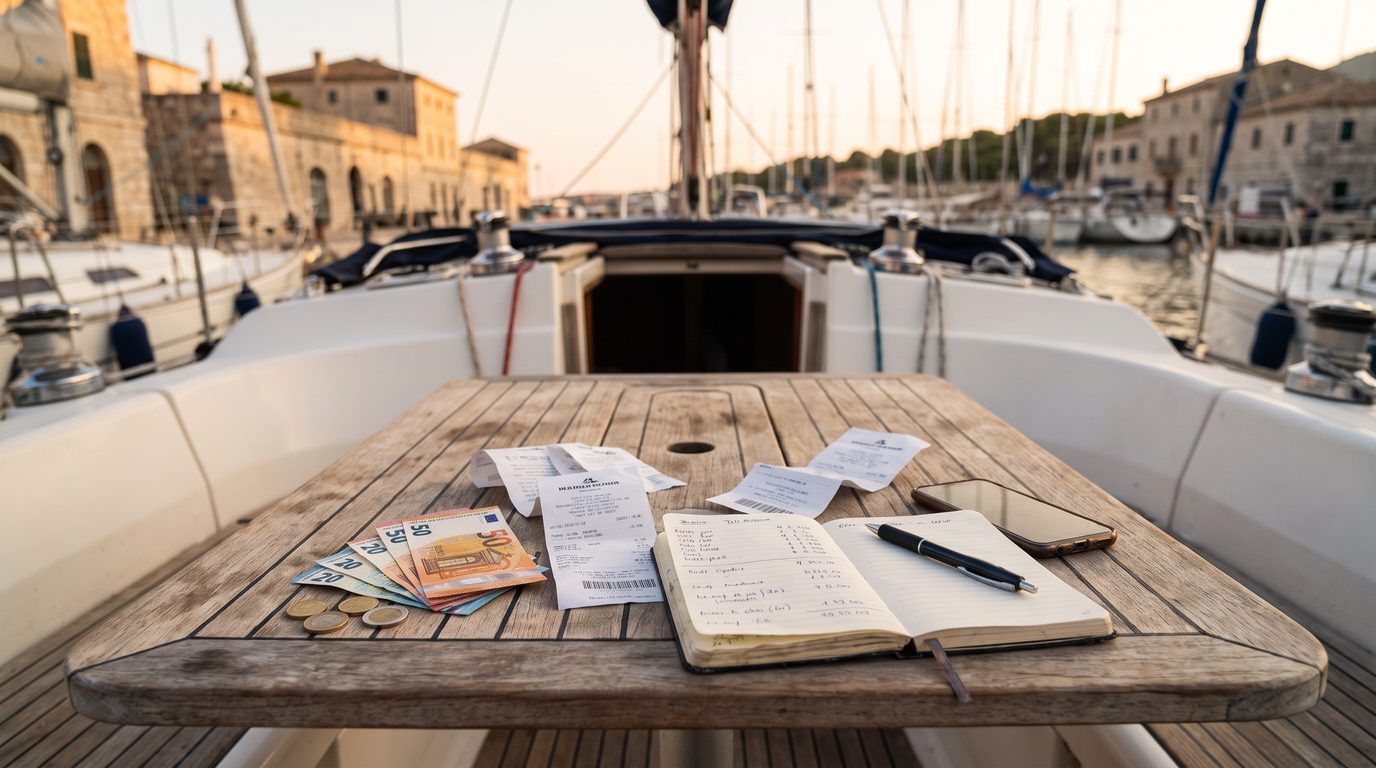
The charter price is in the contract, divide by eight, done. That's how many crews calculate — and then wonder on day three why the kitty is already half empty. The charter price is only half the bill. The other half builds up along the way: harbour fees, diesel, groceries, tourist tax, restaurants. And it's exactly this half that gets underestimated on almost every trip.
This article shows what a sailing trip really costs: item by item, with figures per person per day, a worked example for a week in Croatia and a comparison with the Baltic. And with the answer to the question that comes up on every trip at some point: who actually pays for the skipper?
Three pots that have nothing to do with each other
Before anyone names a figure, it pays to separate things cleanly. A sailing trip has three blocks of costs, and arguments almost always start when they get mixed up.
The charter price. It's in the contract and paid weeks before the trip, usually in two instalments. Depending on yacht, cruising area and season, between €2,000 and €6,000 a week. It's divided by the number of berths, not the number of people — anyone who has a double cabin to themselves usually pays for both places.
The deposit. A security paid to the charter company, usually €1,500 to €4,000, lodged by credit card and refunded in full if the boat is returned undamaged. It isn't an expense but a risk — and the crew should have talked about it before the trip, not after the scratch in the gelcoat. How to prepare the check-out so the deposit comes back is covered in our charter check-in checklist.
The kitty. Everything that comes up along the way and benefits the whole crew. That's the pot this article is about.
What belongs in the kitty
The kitty is the shared fund for shared expenses. It covers:
- Harbour fees, including water and electricity on the pontoon
- Diesel for returning the boat with a full tank
- Food and drink on board
- Tourist tax and residence fees, charged per person per night in Croatia
- National park and nature park fees, for example for the Kornati islands or Mljet
- Gas, final cleaning, bed linen, if not included in the charter price
- Shared restaurant meals, when the whole crew is there
Personal expenses don't belong in the kitty: ice cream on the pontoon for your own children, souvenirs, the taxi to the airport, the cocktail only two out of eight people drank. Exactly where the line is drawn is up to each crew. What matters is that it's drawn before casting off.
The five big items, with figures
The following figures are ranges from experience for a 40 to 45-foot yacht with six to eight people in high and shoulder season. They don't replace research for your specific cruising area, but they show the order of magnitude of the kitty.
1. Harbour fees: the biggest item and the hardest to plan
In the Mediterranean, the harbour bill depends almost entirely on how often the crew wants to go into a marina. For a yacht between 12 and 14 metres in Croatia:
- Large marina, high season: €100 to €200 per night
- Town harbour or municipal quay: €50 to €100
- Mooring buoy in a bay: €40 to €80, often with a restaurant visit expected in return
- Anchoring: free
A typical week with three marina nights, two town harbours, one buoy and one night at anchor adds up to €500 to €700 for the boat. If you want an ACI marina every night, this item doubles. If you anchor a lot, it halves.
2. Diesel: manageable, but due on the last day
A charter yacht of this size uses three to five litres per hour under engine. A week adds up to 15 to 25 engine hours: harbour manoeuvres, calms, motor-sailing back upwind on the last day. That comes to 60 to 120 litres, or €120 to €250, due at the fuel dock shortly before check-out.
The amount is small but has a catch: it comes right at the end, when the kitty is already empty. That's why it belongs in the budget from the start.
3. Provisions: the item the crew controls
If you cook on board, €15 to €25 per person per day for food and drink is enough. Breakfast, lunch as a salad or sandwich, two or three dinners on board, plus water, coffee, beer and wine. The big shop on day one typically comes to €400 to €600 for eight people, followed by small top-up shops in the harbour towns.
How to plan this without chaos, what quantities per person are realistic and what to watch out for with allergies is covered in our article on meal planning for a sailing trip.
4. Restaurants: the item that blows the budget
Dinner in a konoba (a traditional Croatian tavern) by the harbour costs €30 to €60 per person with drinks, and more on the pontoons of the well-known islands. The question isn't whether the crew eats out, but how often. Two or three times a week fits within the €25 to €40 per day range. Eating out every evening doubles the kitty.
This is exactly where an honest conversation up front pays off. A crew in which three people want to go ashore every evening and five would rather cook needs a rule on whether restaurant meals go through the kitty or everyone pays for themselves. Split mode solves this neatly: only those who were there pay.
5. Tourist tax, national parks, extras
In Croatia there's a residence fee of around €1 to €1.50 per person per night, usually settled via the charter base. National parks cost extra: for the Kornati, the day ticket for a yacht of this size costs between €60 and €200 depending on when you buy it; Mljet charges admission per person. Then there are small things like a gas bottle, ice for the cool box or the laundry in the marina. Together that's €80 to €150 a week for the crew.
Worked example: one week in Croatia, eight people
| Item |
For the boat |
Per person |
| Harbour fees (3× marina, 2× town harbour, 1× buoy, 1× anchor) |
€600 |
€75 |
| Diesel (approx. 90 litres) |
€180 |
€23 |
| Food and drink on board (7 days) |
€1,120 |
€140 |
| Restaurants (3 evenings, €40 per person) |
€960 |
€120 |
| Tourist tax, national park, gas, odds and ends |
€120 |
€15 |
| Subtotal |
€2,980 |
€373 |
| Buffer 15 % |
€450 |
€56 |
| Total kitty |
€3,430 |
€429 |
Around €430 per person for a week, of which a good €55 is buffer that flows back if the trip is quiet. Without restaurants and with more nights at anchor, the total drops to around €250. With a marina every day and dinner ashore, it rises to €600 and more.
For comparison: the charter price of a 45-foot yacht in July is around €4,500, so a good €560 per berth. That makes the kitty almost as large as the charter share. If you leave it out of your first conversation with the crew, you're setting up surprises for later.
Baltic, North Sea, shoulder season: what changes
In the Baltic, the calculation is partly reversed. Harbours are considerably cheaper at €20 to €45 per night, and you spend almost every night in harbour because there are hardly any anchorages. On the other hand, groceries in Denmark and Sweden cost noticeably more than in Croatia, and restaurant meals come to €40 to €70 per person. Overall, Baltic crews end up at €20 to €35 per person per day.
In the shoulder season, harbour fees in particular go down, often by a third in the Mediterranean. Diesel, on the other hand, goes up, because you motor more in unsettled weather. And off-season training trips are usually cooking trips: a lot on board, little ashore, and correspondingly cheap.
Who pays for the skipper?
The question comes up on every trip where it isn't a friend from the crew taking the helm. The answer follows an old seafaring custom: on skippered trips and skipper training, the crew covers the skipper's share of the kitty. The skipper brings their qualifications and responsibility, the crew brings their food. With eight people, that's around €50 per head for the week.
On private trips among friends, however, the skipper pays like everyone else. Both rules are common; the only mistake is not saying which one applies beforehand.
Four mistakes crews make again and again
Budgeting too tightly. If you set off with €150 per person, you'll have to top up on day four — and asking for more money is the least popular conversation of the trip. Better to start with a buffer and pay back at the end.
Forgetting restaurants. Hardly any crew cooks seven evenings. If you don't plan for the three konoba evenings, you underestimate the kitty by a third.
Overlooking the diesel. It comes on the last day, when the pot is empty.
Not clarifying the rules in advance. What counts as a shared expense, how will you settle up, what about the skipper? A ten-minute conversation before the trip saves a two-hour discussion on the last evening.
Turning the estimate into a clean settlement
The budget is the first step. The second is recording expenses along the way so nobody has to puzzle out at the end who paid for the diesel.
In Sailto, the crew sets up a shared kitty for this. In split mode, whoever happens to be paying covers the cost, photographs the receipt, and at the end the app calculates the settlement with as few bank transfers as possible — usually two or three instead of twenty. In pot mode, everyone pays the calculated amount in up front, and the pot's balance is visible to everyone. Which mode suits which crew is compared in the article Sharing the kitty fairly.
The kitty in split mode is free for good in Sailto, for unlimited trips and with no crew limit. Pot mode is part of the Trip Pass for a one-off €14.99 per trip — which, fittingly, can be split via the kitty.
Conclusion
On top of the charter price, a sailing trip costs around €25 to €40 per person per day in kitty expenses — so €200 to €300 for a week in the Mediterranean, and considerably more with lots of restaurant meals. The biggest levers are marina nights and dinners ashore — both decisions the crew makes together. If you go through the items beforehand, plan a buffer and state the rules, there'll be no surprise on the last evening. Just, at most, a refund.