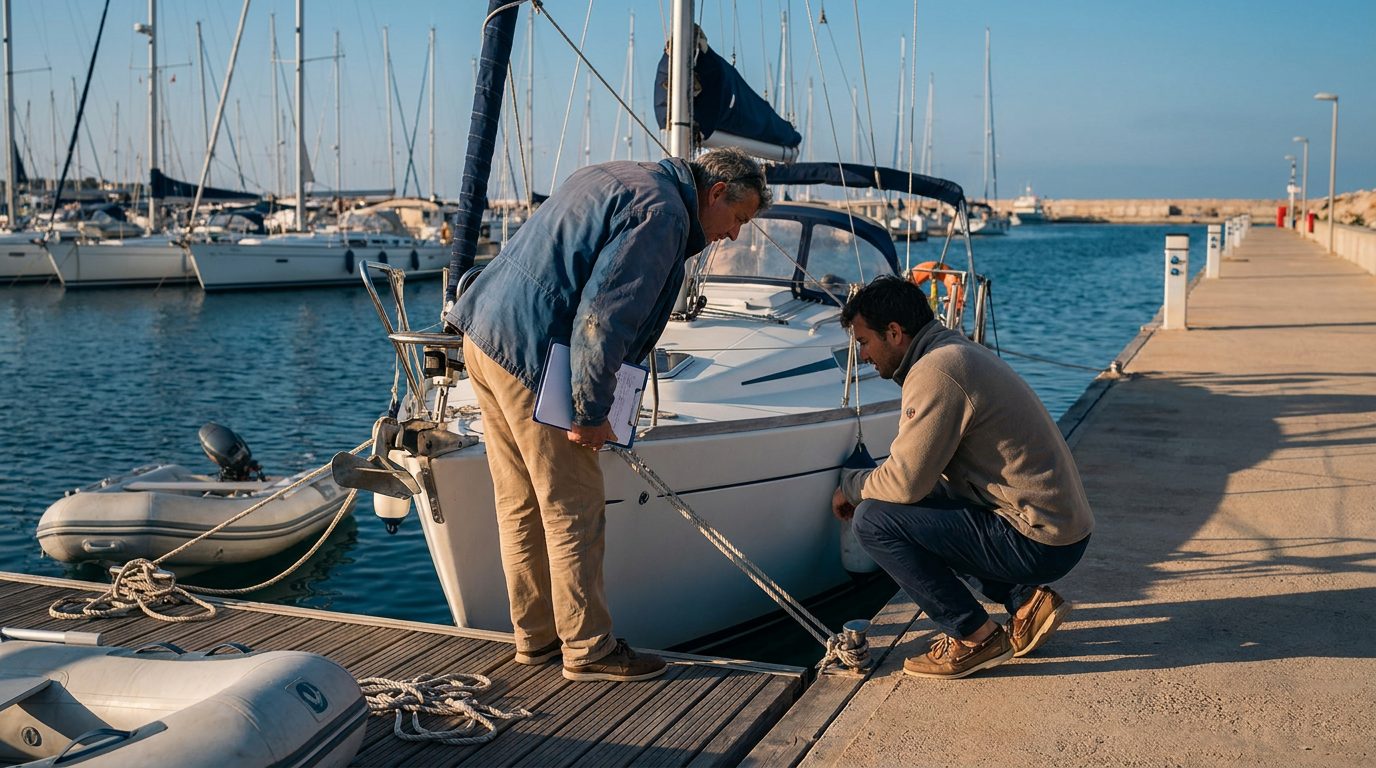
A thorough charter check-in decides whether your trip starts relaxed or ends in an argument over the deposit. And yet it goes the same way almost everywhere: you arrive at the base after a long journey, the base manager has three other crews on the pontoon at the same time, and everything has to be quick. Handover report at top speed, sign here, keys there, have fun and fair winds.
Two weeks later, at check-out, comes the nasty surprise: a scratch on the hull that you supposedly caused. You cannot prove otherwise. Your deposit? Gone, for now.
This is exactly where it is decided whether your trip begins relaxed or with a nagging feeling. The charter check-in is not paperwork to nod through. It is your insurance against precisely that moment at check-out.
What the charter check-in is really about
Deposits today are often between €2,000 and €3,000, and for large catamarans sometimes more than €8,000. By far the most common point of dispute is damage to the hull, stern and superstructure. "Wear and tear or your doing?" is almost impossible to settle at the end of the trip, but takes a minute at the start.
The second issue is whether things work. Does the engine start, is cooling water coming out of the exhaust, does the furling jib run freely? Whatever you do not check on the pontoon will come back to bite you by the time you are approaching a harbour in 25 knots.
So the rule is: check the boat first, then bring the luggage aboard. And take the time you need, even if the base is pushing.
The charter check-in checklist, area by area
It is best to work through this charter check-in checklist from bow to stern and then below deck. If you have a larger crew, split up the areas and the check-in takes half an hour instead of two.
Deck, rig and sails. Inspect the bow and gelcoat for cracks and dings, check the guardrails and stanchions, look over the mast and shrouds. Take a look at the mainsail and furling jib — ideally with a test unfurl. Are the split pins taped?
Anchor and ground tackle. How long is the chain really, and is it marked? Run the windlass up and down briefly and ask how to let the chain out manually if the power fails.
Cockpit and steering. Helm moves freely, instruments plausible, winches and clutches in order. Have someone show you the emergency tiller — you do not want to be looking for it in a swell.
Outside of the hull — and now for the most important tip: lift the fenders. That is where typical berthing damage hides. Photograph each scratch individually and enter it in the report. Many experienced skippers film a complete walk round the whole boat, with a timestamp. That is your best life insurance against a deposit dispute.
Engine and drive. Start it, shift gears, check the cooling water, oil level, V-belt — is the engine bilge dry? Note the fuel level, and if in doubt fill up. And ask when it was last serviced.
Electrics, water, gas. Battery main switch, navigation lights, VHF with channel 16 and DSC, AIS and chartplotter. Fresh-water tanks, heads and all seacocks. For the gas, have someone show you the shut-off and ask for the gas safety certificate.
Safety equipment. Here it is not just about whether it is "there", but about the dates: lifejackets in the right sizes and numbers, service date of the liferaft, inspection date of the fire extinguishers, expiry date of the flares. Write down the figures — they may matter later.
Dinghy, inventory, papers. Briefly test the dinghy and outboard, go through the inventory list (anything missing at check-out will be charged to you), and keep the ship's papers, the charter contract, the crew list and the base's emergency numbers to hand.
Finally: have the handover report signed by both sides. Only then is the condition formally recorded.
The practical trick at boat check-in
Report defects, lines that are too short or missing tools on the pontoon, not once you are under way. On the pontoon you get a replacement; out at sea you just get annoyed. And a skipper who works through the check-in calmly and systematically wins the crew's trust straight away. They can tell whether someone knows what they are doing.
The printable checklist
So that you do not forget anything on the pontoon, the complete check-in is available as a PDF: thirteen areas from the foredeck to the documents, 69 checkpoints. Each item says what to record — PHOTO for everything that should be photographed, QUANTITY and DATE where a figure or an expiry date needs to be entered. Both form the basis for charges at check-out.
The last page is the handover report: key details of the yacht, a table for damage found including photo number, and signatures from both sides.
Download the charter check-in checklist as a PDF — four printable pages, no sign-up and no email address needed.
It is the same checklist that is stored in Sailto as a system template. What you print here, you will find there too — except that the photos are attached directly to each checkpoint instead of sitting in your camera roll.
Charter check-in with Sailto: split the areas across the crew
The classic check-in rarely fails for lack of knowledge, but because of the rush and because one person tries to check everything alone. That is exactly what we turned around.
In Sailto, the skipper starts the charter check-in and assigns individual areas to crew members. One takes the deck and rig, one the engine and systems, one the safety equipment. Everyone works through their area on their phone, ticks items off, enters quantities and service dates and photographs damage directly at the relevant checkpoint. Everyone sees in real time what has already been done.
At the end you have a complete, documented check-in with photos, instead of a crumpled sheet of paper and "I think that scratch was already there". A tedious hour of going it alone becomes twenty minutes of teamwork.
Frequently asked questions about charter check-in
How long does a proper charter check-in take?
A good hour on your own; with the areas split across the crew, often just 20 to 30 minutes. Build the time into your plan and do not let yourself be rushed.
What do I do if there is damage during the trip?
Document it immediately, with photos and ideally in writing, and inform the base. The cleaner the documentation, the smoother it will be to settle via the deposit.
Is deposit insurance worth it?
For many people, yes. Deposit insurance covers the excess that is retained in the event of damage, and the premium is roughly a few per cent of the charter price. Whether it pays off depends on the cruising area, the size of the boat and your gut feeling.
What should I watch out for at check-out?
As a rule: return it with full tanks, top up the fresh water, empty the holding tank, take the rubbish off, and leave it tidy and clean. Otherwise you risk deductions. And keep your check-in photos until the deposit is back in your account.
By the way: what comes before the check-in is set out in the charter contract — above all the clauses on deposit, excess and place of jurisdiction, which in a dispute decide how much your photos are worth in the end. Right after the check-in comes the safety briefing on board — which you can also complete with Sailto in a few minutes, including binding confirmation from the whole crew. And if you are still packing: the sailing trip packing list covers what belongs on board and what the yacht already provides.
If you want to read up in more depth beforehand, experienced cruising sailors have written detailed guides to taking over a charter yacht (in German). The basic logic is always the same, though.
A proper check-in costs you half an hour and may save you a few thousand euros. If you want to do your next charter check-in as a team and with complete photo documentation, take a look at Sailto.