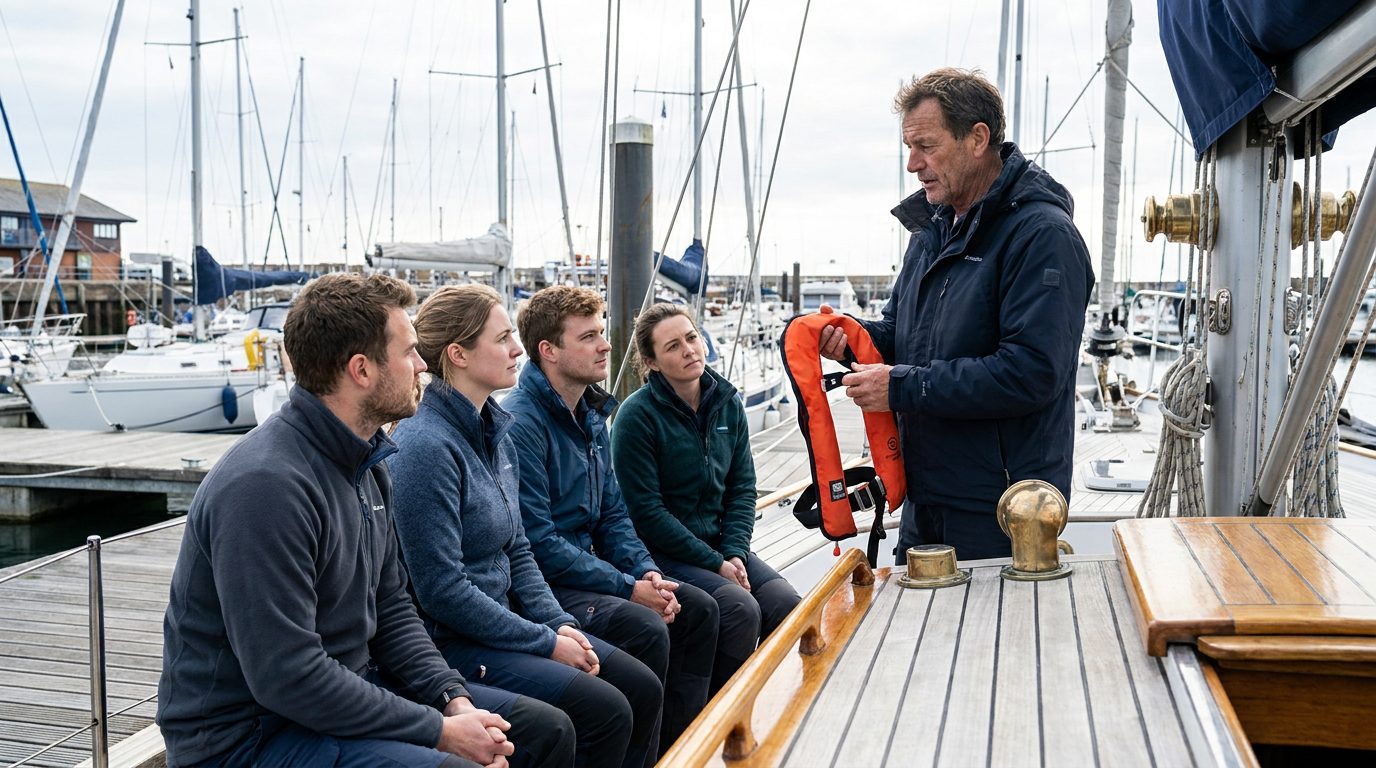
Day one: the yacht, freshly checked in, is lying in her berth, the sun is beating down on the deck and the crew wants just one thing — to cast off. And you? You're supposed to do the safety briefing now.
Be honest: how often have you rattled it off at top speed while half the crew was already mentally in the first bay? "Lifejackets are in the cockpit locker, the fire extinguisher's over there, you'll be fine." Three minutes, box ticked, lines off.
The problem is this: a briefing nobody remembers isn't a briefing. It's a box ticked for your conscience. And when something really does go wrong, suddenly there's someone at the helm who doesn't know where the MOB button is.
Why the safety briefing isn't a tedious ritual
As skipper, you are responsible for the boat and crew. That isn't a line for the logbook; it's everyday reality as soon as the lines are off. If you skip the briefing and something happens, that can quickly be regarded as gross negligence — and then things can get uncomfortable with your insurance cover too.
But paperwork aside: most accidents on board aren't Hollywood dramas. It's the fall on the way to the foredeck, the head against the boom, the hand in the winch. That's exactly what you prevent with ten calm minutes in harbour, before the boat starts rolling and attention drops.
What really belongs in a good safety briefing
You don't have to explain every screw. You have to explain the things that matter in an emergency. This is the framework that has proven itself over the years.
Moving around on board. The golden rule first: one hand for the boat, one for yourself. Hold on to solid fittings, not the guardrail wires. Go forward on the windward side and climb down the companionway backwards. Sounds trivial, but it prevents most bruises and worse.
Lifejackets — done properly. Everyone gets their own lifejacket for the whole trip and puts it on once. Don't forget to fasten the crotch strap, otherwise the thing rides up over your head in the water. With charter lifejackets it's worth a quick look at the indicator window to check that the cylinder is still showing green.
Man overboard. Everything is decided in seconds here, so assign the roles in advance: one person points continuously at the casualty and never takes their eyes off them. One throws the lifebuoy and danbuoy. One presses the MOB button on the chartplotter. One helms the manoeuvre. Anyone who has talked it through once as a dry run won't freeze in a real emergency.
Fire, gas and water ingress. Where are the fire extinguishers, and how do they work (aim at the base of the flames, not into them)? Where's the fire blanket? For gas, the rule that saves lives: propane is heavier than air and collects low down, so if you smell gas — no switches, no sparks, ventilate first and turn off the gas. And show the seacocks, together with the wooden bungs that hang next to them on many charter yachts.
VHF radio, liferaft and emergency roles. At least one other person must be able to send a distress call in case you're out of action. Channel 16, DSC distress button, done. Show the liferaft, together with the rule that you only step into it when the deck is already under water. And finally, everyone gets a fixed task for emergencies.
The real secret: show, don't read out
The best briefing doesn't talk — it gets people doing. Instead of "the fire extinguisher's back there", try: "Tom, show me where the fire extinguisher is." Instead of a monologue, three points, then a quick question to the group. Anyone who has to answer suddenly wakes up.
Professionals have been doing it this way for years: short, concrete, with small lightbulb moments. Nobody remembers fifteen minutes of non-stop talking. But everyone remembers the sentence "propane sinks" once it's been said and then asked about shortly afterwards.
Why everyone should confirm at the end
Now for the part almost everyone leaves out: the confirmation. Not because paperwork is nice, but because it does two things. First, it makes everyone pause briefly and say "yes, understood" instead of just nodding. Second, it protects you as skipper, because it documents that you gave the briefing.
An honest note on this, because there's a lot of nonsense online: a confirmation like this is evidence that the briefing took place. It isn't a free pass or a waiver of liability — you can't sign away gross negligence. It records "I was briefed and I understood", and when in doubt that is worth its weight in gold.
The briefing to print
So that you don't have to brief from memory, the complete checklist is available as a PDF — thirteen sections from moving around on board to emergency roles, 58 points, 33 of them marked as mandatory. Each point has a one-line explanation of why it matters — exactly the sentences that stick when you're showing things.
The last page holds the confirmation with signature lines for ten crew members.
Download the safety briefing as a PDF — five pages to print, no sign-up and no email address required.
It's the same checklist that is stored in Sailto as a system template. What you print here, you'll find there again — just with digital confirmation instead of a pen.
How we solved it in Sailto
To be honest, it was exactly this moment in harbour that got us started. We wanted a briefing that sticks and doesn't get lost in the chatter.
In Sailto, the skipper starts the safety briefing and the whole crew gets a link. Everyone opens it on their own phone and works through the sections interactively, with short "Why does this matter?" snippets and mini quiz questions that make the knowledge stick. When someone ticks something off, everyone else sees it in real time. And right at the end, everyone confirms by name that they have understood the briefing. As skipper, you see at a glance who is ready and who isn't yet.
The three mumbled minutes become ten that really sink in — and you have the confirmation in black and white.
Frequently asked questions about the safety briefing
Is a safety briefing on a charter yacht mandatory?
There's no rigid rule with a stopwatch, but as skipper you are responsible for your crew's safety. If you skip the briefing and something goes wrong, you risk being accused of gross negligence. In practice that means: always do it.
How long does a good briefing take?
In harbour, with the boat steady, a sensible briefing takes about ten to fifteen minutes. It only takes longer if the crew is sailing for the very first time.
Should the crew sign the briefing?
A confirmation is highly recommended. It serves as proof that you gave the briefing and ideally also goes in the logbook. In Sailto, everyone confirms digitally with a timestamp.
What does this have to do with my insurance?
If something goes wrong, the insurer will check whether you fulfilled your duty of care as skipper. A documented briefing is a strong argument on your side.
A crew that knows where everything is and what to do sails more relaxed. And you'll sleep more soundly on the first night at anchor. If you don't want to do your next briefing off the top of your head, try Sailto and get the whole crew involved via a link.
Just before the briefing comes the boat check-in, by the way — and if you're still packing, the sailing trip packing list covers the gear that plays a part in the briefing.