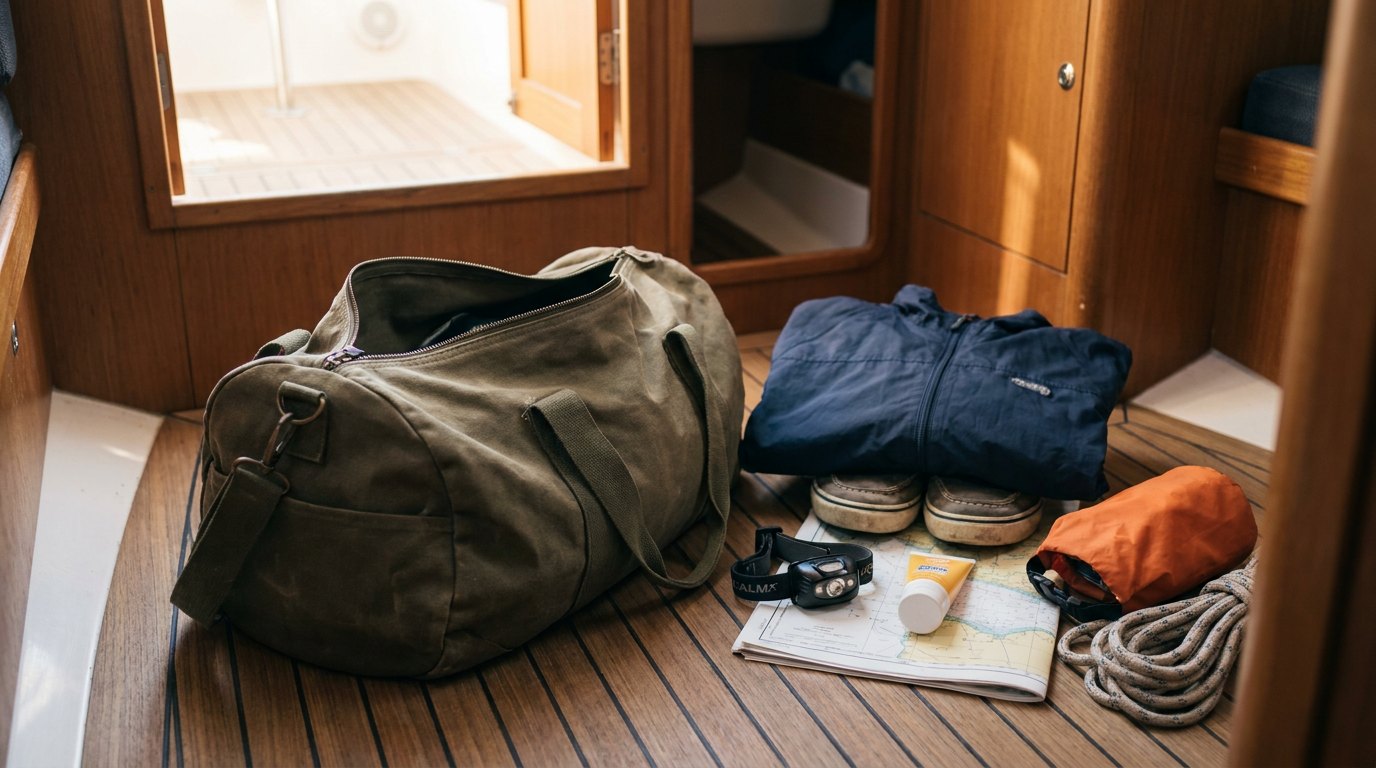
The holdall sits open on the bed, next to a pile that is clearly too big. Three pairs of shoes, six T-shirts, the thick cotton jumper, a hairdryer. And at the same time that nagging feeling that you're forgetting the most important thing.
Usually both are true. The typical sailing-trip bag is too full and incomplete at the same time. Too full because different rules apply on land. Incomplete because the three or four things that can't be replaced along the way are missing.
This packing list turns that around: first the things that really have to come, then the ones that can safely stay at home — plus an honest answer to what a charter yacht already carries.
The one rule most people get wrong
Before anything goes into the bag, success is decided by the bag itself: soft, never a hard-shell suitcase.
The reason is mundane, yet it is learned anew every season. The lockers under the berths of a sailing yacht are shallow, curved and follow the shape of the hull. A soft bag can be emptied, rolled up and tucked away inside. A suitcase can't. It spends the week in the saloon, the passageway or the heads, in everyone's way — and with eight people on board, that's eight times over.
Second most important rule: think in layers, not outfits. A quick-drying base layer, a light fleece for the evenings and something windproof on top. Cotton is the worst fabric you can pack for a boat — it soaks up water and won't dry for days in the damp cabin air.
What really has to come
This group is small, and that is exactly why it matters: it contains everything that can't be replaced along the way.
ID and licences. ID card or passport, your sailing licences, your radio certificate if you have one, your health insurance card. No licence, no check-in — and the base won't accept a photo on your phone if the original is missing.
Personal medication. Your regular medication in sufficient quantity, with the patient leaflet. A general first-aid kit is part of the boat's equipment, but it doesn't know your prescriptions. There is no pharmacy in a bay in the Kornati islands.
Seasickness remedies. Even if you think you won't need them. They weigh nothing, and the day you need them is always the day the wind picks up.
Deck shoes with light-coloured soles. Dark soles leave marks on the deck, and those end up on the check-out bill. One pair is enough.
SPF 50+ sun protection and sunglasses with a strap. On the water the sun hits you from above and from below. Underestimate that and you'll spend day three below deck. The strap on your sunglasses isn't an accessory — without it they'll end up on the seabed sooner or later.
What you can safely leave at home
The second half of a good packing list is the list of things that stay behind.
Lifejackets are mandatory equipment on every charter yacht and are checked for the right size and number during the boat check-in. People who sail a lot like to bring their own because it fits better — for your first trip it's unnecessary.
Bedding is included in the price with most charter companies, and towels often are too. Both are stated in the charter contract; a quick look saves you several kilos. What is almost never on board, though: a beach towel.
Crockery, cutlery, pots and pans, basic cleaning products are standard equipment. You don't need to bring a frying pan.
Hairdryer, iron, a third pair of shoes. Shore power is rarely enough for heating appliances, and you'll be barefoot or in deck shoes anyway.
The packing list by category
This is the basic kit that works on any sailing trip — regardless of cruising area or season.
Documents: ID card or passport, sailing licence(s), radio certificate, health insurance card.
Clothing: sunglasses with a strap, deck shoes with light-coloured soles, rain jacket or foul-weather gear, spare swimwear, a hat. Plus the layers: base layer, fleece, windproof jacket, a pair of long trousers for restaurant visits.
Safety: sailing gloves — by the third manoeuvre at the latest you'll know why.
Toiletries: SPF 50+ sun cream, thin quick-drying towels, travel first-aid kit, seasickness tablets.
Miscellaneous: soft holdall, earplugs, charging cables and power bank, head torch.
The earplugs are on the list for a reason. A yacht isn't a quiet place at night: halyards slap against the mast, the anchor chain grinds, and someone in the crew always snores.
The list to take with you
This packing list is available as a PDF to print and tick off — with all three versions: the basic kit, a summer list for the Mediterranean and one for training trips.
Download the sailing trip packing list as a PDF — three lists, 60 items, no sign-up and no email address required.
It's the same list that is stored in Sailto as a system template. What you print here, you'll find there again.
Two versions for special trips
Mediterranean in summer. Fewer warm clothes, more sun protection: after-sun, insect repellent, flip-flops for the pontoon, a dry bag for valuables in the dinghy. Snorkelling gear is worth bringing because it's rarely on board. The rain jacket still comes along — a thunderstorm in the Adriatic is no myth.
Training trips and skipper training. Add a textbook and course materials, a notebook and pen, navigation instruments with dividers and plotting triangles, often a hand-bearing compass and binoculars. And because training trips tend to take place outside the high season: warm hat, waterproof trousers, proper foul-weather gear.
Why paper packing lists fail
A printed list has a built-in flaw: it only knows one person. As soon as a crew comes together, it breaks down into questions nobody answers centrally.
Who's bringing the snorkelling gear? Is anyone packing a spare charging adapter? The skipper wants everyone to have a head torch — has everyone read that? And the two who join later never saw the first message in the group chat.
That's why Sailto brings the three levels together: system templates as the foundation, required items from the skipper that apply to everyone and have to be visibly ticked off, and personal additions that only the person concerned can see. Everyone sees their part, the skipper sees the overall status — without having to ask once.
And if you need the list again next year, you save it as your own template instead of typing it out again.
Frequently asked questions about packing
What do I absolutely have to bring on a sailing trip?
ID, licences, health insurance card and personal medication — everything that can't be replaced along the way. Straight after that, deck shoes with light-coloured soles, sun protection and weatherproof clothing. The rest is comfort and can be bought locally.
Suitcase or holdall?
Always the soft bag. A hard-shell suitcase can't be stowed on board and is in the way all week.
How much luggage is realistic?
One full holdall per person plus a small day rucksack. With eight people, every extra item adds up.
Do I need my own foul-weather gear?
For a Mediterranean summer, a light rain jacket is enough. For the Baltic, the North Sea and the shoulder season, proper foul-weather gear is worth it — charter yachts don't provide any.
Conclusion
Packing well doesn't mean packing a lot. It means: the four or five irreplaceable things safely with you, everything else light, quick-drying and in a bag that rolls up out of the way.
If questions remain after that, they're usually not about luggage but about provisions — everything on that is in our article on meal planning for a sailing trip.
And if you want the list not as a sheet of paper but as something the whole crew ticks off together: Sailto is free for that — for unlimited trips and with no crew limit.