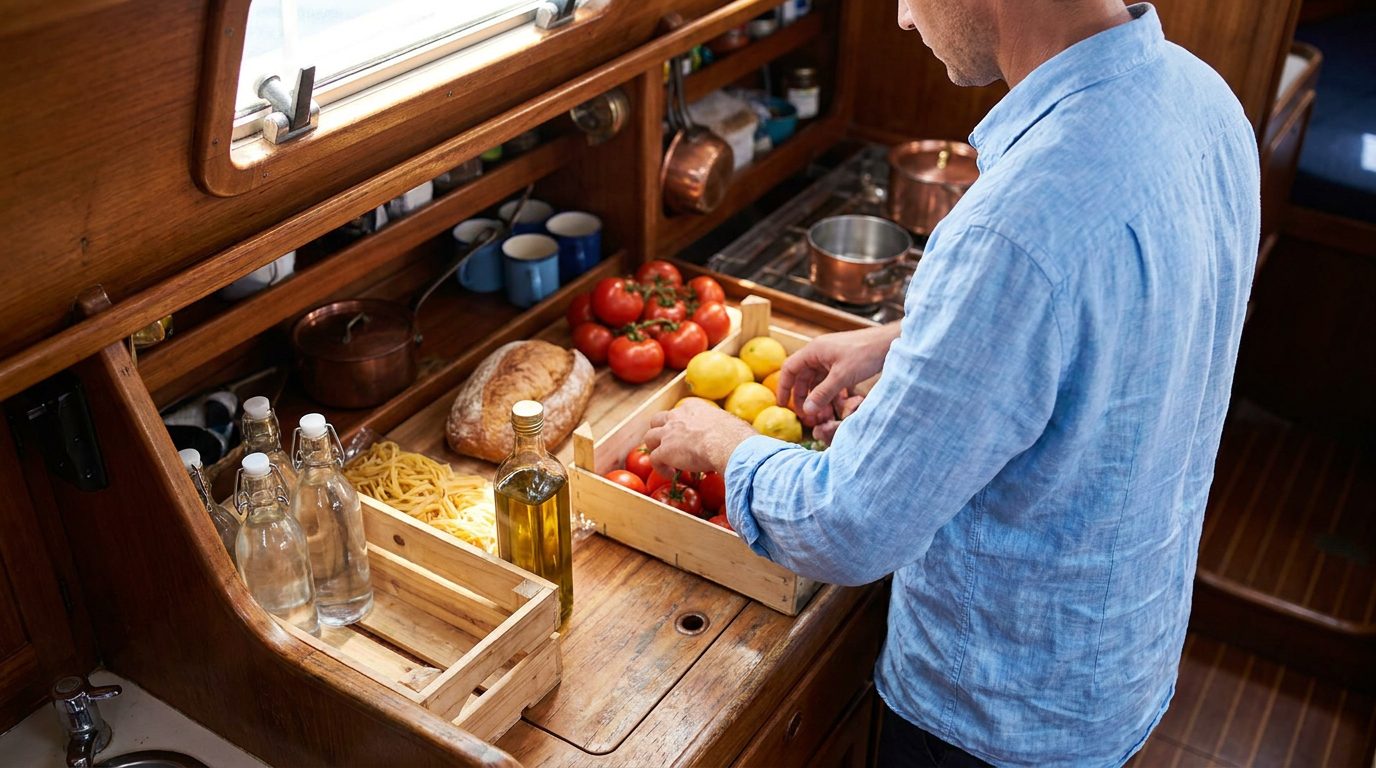
Arrival day in Split. The charter handover took two hours longer than planned, you want to cast off in three hours — and now the whole crew is in the Konzum supermarket pushing three trolleys through the aisles. Eight people, one week, and nobody knows how much bread eight people eat in seven days. Two are vegetarian, one is lactose intolerant, one picks the olives out of every dish. In the end there is no breakfast for day 5, while two kilos of tomatoes are going mouldy on day 3 in a fridge that is far too small. That is what meal planning on a sailing trip feels like without a system.
On every charter trip, food is the underestimated source of stress. It decides the mood, the budget and whether the galley becomes a feel-good zone or a war zone. In this article we show you the typical problems with meal planning on a sailing trip — and how to clear them out of the way completely with a little structure (and the right app). Including quantity rules of thumb to take away.
Why meal planning on a sailing trip is such a pain
On land, meal planning is trivial: you go to the supermarket when something runs out. On a sailing trip that safety buffer disappears. The next shop may be a day's sail away, the fridge holds a fraction of what yours at home does, and you are cooking for a group whose eating habits you often barely know. Three things make provisioning a boat particularly fiddly:
- Limited resources: little refrigeration, little storage, two gas burners, no oven.
- A mixed crew: vegans, vegetarians, people with allergies and meat-eaters at one table.
- No second chance: whatever you forget on arrival day may be missing for the whole week.
The 7 most annoying problems with food on board
1. Everyone in the crew eats differently
Two vegetarians, one vegan, one person who is lactose intolerant, plus someone who hates fish: a crew of eight almost always brings four different dietary profiles. If you only notice while cooking, you end up with a pot of bolognese that half the crew will not eat. Diets and allergies need to be known before the shop — not at the stove.
2. Calculating quantities is a matter of luck
How much pasta for eight people? How many breakfasts will actually be eaten on board and how many at the harbour bakery? Underestimate and you are sitting in a bay with no supermarket and no dinner. Overestimate and half of it goes off in the 40-litre fridge — expensive and annoying.
3. The fridge is tiny
A typical charter fridge holds much less than the one at home, cools less well and shares its space with the drinks. Fresh food needs to be rotated cleverly: whatever goes off first gets eaten first. Supplies that do not need refrigeration — hard cheese, eggs, robust vegetables, tins — are worth their weight in gold at sea.
4. Drinks are chronically underestimated
Drinking water, coffee for the early risers, soft drinks for the afternoon, the evening beer at anchor: drinks make up a large share of weight and budget — and yet they are the thing most often forgotten in planning. Water in particular is underestimated: in summer heat, 2 to 3 litres per person per day is realistic.
5. The big shop on arrival day is under time pressure
The handover drags on, the supermarket is unfamiliar, the labels are in another language, and you want to reach the first bay before dark. Without a finished shopping list, this shop turns into a headless race — with three trolleys buying the same tomatoes side by side.
6. Who shops, who cooks, who pays?
Without clear responsibilities, either one person buys everything alone (and gets fed up) or everyone buys at random (and you end up with duplicates). And at the end comes the question of how to settle the food fairly through the kitty.
7. Nobody knows the likes and dislikes
Allergies are the hard limit — but preferences also decide the mood on board. One person hates coriander, another loves it spicy, a third does not drink alcohol. Details like these disappear in WhatsApp threads instead of being in one place where the person cooking will actually see them.
How to approach meal planning in a structured way
The good news: meal planning on a sailing trip is not rocket science if you break it down into five steps.
- Collect the crew's preferences in advance — each person's diet, allergies, dislikes and favourite drinks, ideally in one central place rather than scattered around the group chat.
- Draw up a meal framework — how many breakfasts, lunches and dinners on board, how many restaurant evenings? That tells you how many meals you actually need to shop for.
- Derive the shopping list from the plan — the ingredients for each dish, grouped by supermarket category (chiller, dry goods, drinks).
- Calculate quantities with rules of thumb — per person per day rather than by gut feeling (table below).
- Share out the tasks — who buys which category, who cooks on which day.
Quantity rules of thumb per person per day
These guideline figures have proved themselves on Mediterranean and Adriatic trips. They are generous — appetites are bigger at sea than on land.
| Item |
Per person per day |
Practical tip |
| Drinking water |
2–3 litres |
More in the heat; tank water for cooking only |
| Bread / breakfast |
100–150 g or 60 g muesli |
Crispbread and rusks keep for weeks |
| Fruit & vegetables |
300–400 g |
Robust produce first: apples, carrots, cabbage |
| Side dish (pasta/rice) |
100–125 g (uncooked) |
Dry, easy to store, filling |
| Snacks |
1–2 bars / a handful of nuts |
For night watches and long passages |
| Coffee / tea |
2–3 cups |
A stovetop espresso maker needs no machine |
| Beer / wine |
depends on the crew |
Only plan for crew members who drink alcohol |
How Sailto solves meal planning on a sailing trip
This is exactly where Sailto comes in. Instead of WhatsApp threads and a note on the chart table, all the food-related information comes together in one place — and an AI assistant turns it into a plan at the push of a button.
Crew profiles: diet, allergies, dislikes and favourite drinks
Each crew member enters in their own profile what they can and like to eat: diet (omnivore, vegetarian, vegan, pescatarian), allergies (such as gluten, lactose, nuts), food dislikes (what is a no-go) and their favourite soft, hot and alcoholic drinks — and whether someone does not drink alcohol at all. This happens once, when they join via the invite link. The skipper does not have to chase anyone.
AI meal planner: meal plan and shopping list at the push of a button
The AI meal planner built into Sailto (based on Claude) knows all these profiles — plus crew size, trip length and region. On request it creates a complete meal plan or a ready-made shopping list that can be transferred straight into the boat's shopping list. The principles:
- Nobody is forgotten: vegans and vegetarians always get proper options, and allergens are strictly avoided.
- Dislikes are taken into account: if you hate olives, you will not find them in the plan.
- Drinks are included automatically: water for the whole trip, the crew's favourite soft drinks, coffee and tea for breakfast — and alcoholic drinks only in quantities that suit the crew members who drink.
- Made for a boat galley: recipes are designed for two gas burners without an oven, with ingredients you can actually get in the region.
A shared shopping list instead of three trolleys
With one tap, the AI suggestion becomes a shared shopping list: sorted by category, tickable by the whole crew, with the option of assigning individual items to specific people. On arrival day you split up the aisles instead of buying the same tomatoes three times — and see in real time what is already in the trolley.
You can start for free — crew profiles, shopping list and packing lists are free for good, for any number of trips and with no crew limit. The AI meal planner is part of the Trip Pass, a one-off €14.99 per trip, which unlocks it for the whole crew.
Frequently asked questions about sailing trip meal planning
How much food should I plan per person per day?
As a rough budget rule, allow €10–15 per person per day for self-catering on board (Mediterranean/Adriatic); restaurant evenings come on top. For quantities, the rule-of-thumb table above helps — more important than accuracy to the gram is packing a little extra long-life dry food (pasta, rice, tins) as a reserve.
How much drinking water do I need per person per day?
2 to 3 litres per person per day for drinking, more in great heat. Depending on the charter, water from the boat's tank is better suited to cooking and washing up — drinking water is usually bought separately in bottles or containers.
What can I cook on just two gas burners?
Quite a lot: one-pot pasta, risotto, curries, stews, couscous dishes, shakshuka. Anything that works in one or two pans. Dishes that need an oven or grill are out — Sailto's AI meal planner takes this into account automatically.
How do I plan for vegetarians and vegans in the crew?
The simplest approach is a vegetarian base that can be topped up: one main dish for everyone, with meat or fish as a separate side for those who want it. That way nobody cooks twice. In Sailto, each person records their own diet in their profile, and the AI plans from the outset so that everyone is well fed.
Should I cook in advance or shop locally?
For the first evening, a dish prepared at home is worth it (a chilli, for example) — on arrival day there is rarely time to cook after the handover. The rest is best bought fresh locally, with a finished list in your luggage.
Conclusion: good food starts before you cast off
The most annoying catering problems on a sailing trip do not arise in the galley but beforehand — through missing information and missing structure. If you know the crew's dietary profiles, have a rough meal plan and go to the supermarket with a finished shopping list, you save yourself stress, money and spoiled food.
Sailto takes exactly this groundwork off your hands: crew profiles fill themselves in, the AI meal planner turns them into a meal plan and shopping list, and the shared list makes sure everyone knows what to do on arrival day. Start for free here and keep your crew well fed on your next trip, stress-free.