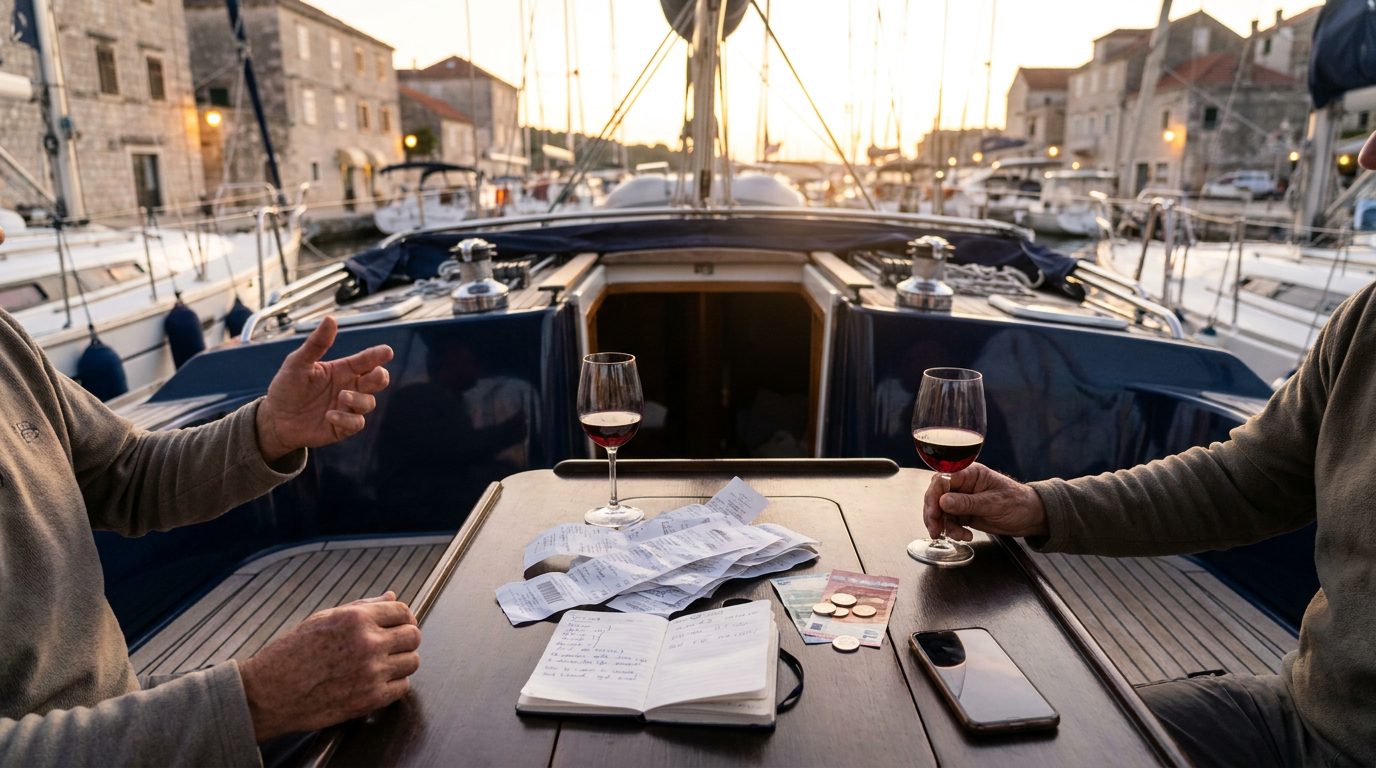
Three days in the Adriatic. The crew has already paid two harbourmasters, a fuel stop, plus bread, vegetables, wine and three restaurants. Nobody knows any more who fronted what. On the last evening you sit in the cockpit, the notebook half empty, half smudged — and you start doing sums. That is what a kitty without a system feels like.
On any charter trip, a well-run kitty — the ship's kitty or "cruising kitty", as many crews call it — is the invisible anchor of the mood on board. Run fairly and transparently, nobody talks about it. Run sloppily, the crew talks about nothing else on the pontoon. In this article we show you five proven methods for sharing the kitty fairly — with concrete examples, pros and cons and a comparison table at the end.
What actually goes into the kitty?
The kitty is a charter crew's shared fund for every expense that benefits the whole crew: diesel, harbour fees, food, washing-up liquid, shared restaurant meals, ice cream on the quay, sparkling water and so on. What usually does not go into the kitty: your own beer at the bar, personal souvenirs, the taxi to the airport.
Three typical points of friction come up on practically every trip:
- Who actually paid for what? Receipts go missing, memories fade, and the WhatsApp group is full of "Just put €80 on diesel".
- What counts as a crew expense in the first place? If only three of eight went to the restaurant — who pays?
- How do you settle up at the end? Seven crew members, one balance — who transfers how much to whom?
The five methods below solve these three problems in different ways. Which one suits your trip depends mainly on crew size, level of trust and trip length.
Method 1: Split mode — everyone pays as they go, settle up at the end
By far the most popular method among experienced crews, familiar to anyone who has used Splitwise. Whoever has an expense pays for it up front. For example: Anna pays the harbour fees in Krk (€62), Boris the fuel stop (€180), Conny the shop at Konzum (€94). All expenses are recorded in a shared list — with date, amount, description and who the expense was for (everyone, a subgroup, one person).
At the end of the trip you get a balance per person. Anna has paid out €230, but her share would be €195 — she gets €35 back. Boris has paid €180, his share would be €195 — he owes €15. A good kitty tool automatically calculates the minimum number of transfers needed to even out all balances (often just 2–3 transactions instead of seven rounds of back and forth).
When does split mode work?
- For crews in which not everyone has the same amount of cash to hand — nobody has to pay in up front.
- When expenses are spread unevenly across the crew (e.g. only 4 of 8 at the restaurant).
- On longer trips, where expenses pile up over two weeks.
Pros
- Maximum flexibility — every expense can be split individually.
- No up-front payment needed.
- With an app, no spreadsheet work.
Cons
- Requires disciplined recording of every expense — otherwise it gets chaotic.
- Several transfers at the end (though these can be optimised down to 2–3).
Method 2: Pot mode — everyone pays into a shared pot up front
The "classic" kitty: each crew member pays a fixed amount in before the trip — say €200 per person, so €1,600 in the pot for a crew of 8. The skipper (or a trusted crew member) manages the pot physically (cash) or digitally (an account). All kitty-related expenses are paid from the pot: diesel, harbour, food, restaurants. At the end, whatever is left is paid back in equal shares — or topped up if the money did not stretch.
When does pot mode work?
- On short trips (a week or less) with a crew that knows each other well.
- When all expenses are planned collectively and nobody pays "extra".
- When one person pays for everything anyway (e.g. the skipper) and the crew pays in.
Pros
- No balances, no transfers at the end — the pot balance is always transparent.
- One person pays; the rest are not constantly checking their bank balance.
- Nobody "forgets" to log an expense — the pot balance would give it away immediately.
Cons
- Everyone has to put cash up front — tricky for mixed crews of students and professionals.
- Those who eat or drink little indirectly subsidise the big spenders.
- Topping up at the end is unpopular if the pot was set too low.
Method 3: Flat fee up front — the skipper calculates, the crew pays a fixed price
Common on guided trips and skipper training. The skipper estimates the likely kitty requirement for the trip in advance (e.g. €250 per person for a week in the Adriatic), collects it before departure and does the bookkeeping alone. Differences are not settled after the trip — the skipper carries the risk and keeps any surplus.
When does it work?
- On guided trips, where the skipper organises everything anyway.
- When the crew does not know each other yet (skipper training, mixed bookings).
- When a fixed price is communicated to guests ("all-in €1,290 per person").
Pros and cons
Pros: Maximum simplicity for the crew — everything sorted before the trip. No bookkeeping on board, no transfers afterwards.
Cons: Requires a lot of trust in the skipper. Risk and surplus sit with the skipper — a spike in diesel prices can hurt. Little transparency for the crew.
Method 4: Separate pots — diesel separate, food separate
A variant that is popular mainly on longer trips or with crews who eat very differently. Instead of one kitty there are two or three:
- Boat pot — diesel, harbour fees, boat consumables. Split equally between everyone.
- Galley pot — food and drinks on board. Whoever eats, pays.
- Restaurant pot (optional) — kept separately for each restaurant visit; whoever does not go, does not pay.
When does it work?
- With mixed dietary preferences (vegan, vegetarian, allergies and carnivores in one crew).
- With crews where some members eat ashore during the day.
- On longer trips (10+ days), where imbalances would otherwise add up.
Pros and cons
Pros: Fairer for crew members with particular eating habits. A clear split: boat costs are non-negotiable, galley costs are not.
Cons: Three kitties instead of one — more admin. Only works with good app support that handles categories.
Method 5: Hybrid — flat base amount plus split mode for extras
The most flexible solution for mixed crews: part of the kitty is paid in as a flat amount up front (diesel, harbour, basic food — e.g. €150 per person). Everything beyond that — restaurants, impulse buys, marina laundry, sundowners — runs through split mode.
This works because the crew's basic cash flow is secured (nobody has to front €300 of diesel first), while individual expenses can still be allocated fairly. Suitable for crews with mixed budgets and trips where restaurant visits and activities are not yet planned.
Comparison table — which method suits which trip?
| Method |
Best for |
Up-front payment |
Effort during the trip |
Settlement at the end |
Fairness with uneven spending |
| Split mode |
mixed crews, longer trips |
none |
log every expense |
2–3 transfers (optimised) |
very high |
| Pot |
close-knit crews, one week |
yes, fixed amount |
low |
refund of remainder or top-up |
medium |
| Flat fee up front |
guided trips, skipper training |
yes, fixed price |
none for the crew |
none |
low, risk with the skipper |
| Separate pots |
different diets, 10+ days |
partly |
high (two or three kitties) |
per pot |
high |
| Hybrid |
mixed budgets, unclear restaurant plans |
yes, base amount |
medium |
few transfers |
high |
As a rule of thumb: the more your crew differs in budget, eating habits and appetite for shore leave, the further down the table your method should be. The closer-knit the crew, the more likely a simple pot will do.
How Sailto helps with the kitty
Whichever method you choose — running the kitty with pen and paper or a half-finished WhatsApp list is no longer necessary in 2026. Sailto covers both common methods (split mode and pot mode), with receipt photo upload, a real-time balance for the whole crew and automatic calculation of the minimum number of transfers at the end of the trip.
- Split mode: split each expense individually, attach a photo of the receipt straight away, live balance for everyone.
- Pot mode: record up-front payments, deduct expenses from the pot, pot balance visible to everyone.
- CSV export for settling up later — for example to hand over to a club or an accountant.
You can start for free — split mode with receipt photos, balance calculation, settlement suggestion and CSV export is free for good, for any number of trips and with no crew limit. Pot mode is part of the Trip Pass, a one-off €14.99 per trip that covers the whole crew.
Conclusion: which method for your next trip?
If your crew knows each other and you are sailing for a short week: pot mode. If you are away for longer or the crew is a mixed bunch: split mode. If you offer trips professionally as a skipper: flat fee. In Sailto you can run both main methods side by side — so you do not have to decide once and for all.
And most importantly: agree on the system explicitly at the start of the trip. "We're using split mode, and we photograph receipts straight into the app" — that one sentence on the pontoon in Trogir or Travemünde prevents 80% of all kitty arguments.
Want to try Sailto on your next trip? Start for free here — no credit card, no crew limit and for as many trips as you like.